Monday, 4 October 2010

Ex Libris James Donald

Not sure if I am making too much of this - but am sat in the special collections library holding Grahame's Birds of Scotland. And on the inside front cover:


Surely that is quite an amazing coincidence - that I should have found a book published in Scotland in 1806 and owned by my great x 4 uncle in a library in Virginia? The book's author died in the same house as James Donald and I believe both are buried in the same lair in Glasgow.

Here's more details about the book - just so you can rush out and get your edition:

Contains a long poem against slavery which I need to get to grips with - but also contains this general note at the end which I liked - his spelling:

Glossary
I have, now and then, used a Scotch or an old English word, where a modern English synonime, equally emphatic, did not present itself. I am no friend to those phrases with are commonly, though often erroneously, called Scotticisms, or to any innovation which would tend to destroy the idiom of the English language; but I could never seen any good sense in the indiscriminating anathema, which would proscribe every word that happens to be unknown, or little known, on the south side of the Tweed.

Anyone who knows what all these words means wins a prize: Bield; Skep; Quern; Know; Cleugh; Blae; Soughing; Shaw; Heartsome; Boutree; Skillet; Cannach; Smiddy; Blawn; Rowan-tree. 

So now I am sat in the same chair that I sat in when I held the letter from Thomas Jefferson to Alexander Donald and am now holding a book that James Donald held - probably even licked the ex-libris sticker and put in in place himself! Hands across history or what.

2018 UPDATE: Booklet on the life and times of Captain James Donald. 

Sunday, 3 October 2010

Too spooky

It is the Sabbath and I said I would avoid my computer etc today, so instead had a haircut, did all my washing, hoovered up stink bugs, went shopping to the mall and took an improving walk in the hills etc.

However, was looking for something in the library collection online in Charlottesville to order up to have ready when I go in tomorrow - swot that I am - when I came across a book - The Birds of Scotland and other poems by James Grahame. Sounds a cracker I grant you.

Didn't take me long to find out that James Grahame is part of the Grahames of Whitehill and indeed actually died at Whitehill:


James Grahame, the second son of Thomas Grahame, was born in 1765, and started in life in 1791 as a W.S. He soon, however, abandoned this profession, and in 1795 was admitted advocate. But his heart was not in the law, and in 1809 he was ordained by the Bishop of Norwich deacon in the Church of England. He acted as curate in one or two parishes, but his health, never good, soon began to fail, and in 1811 he died at Whitehill when on a visit there along with his wife. He was a pleasing writer, and "The Sabbath," which was published in 1804, went rapidly through a number of editions. By his wife, a daughter of James Graham of Blattwood, he left two sons and a daughter.


Whitehill was the house of Captain James Donald at the time James Grahame died there. James Donald had married Anne Grahame. James is the one whose portrait I have at home. You know the one I mean. 


But here is the spooky part, no really - the bookplate of the edition they have in the library here in UVA is James Donald's. It actually belonged to the Captain. 


So who was giving all our books and letters to UVA's library? And what else do they have in there? I am off to the Special Collections library tomorrow to see the book and try and find out how on earth they got hold of it. 


Surely that is quite a weird coincidence? That James Donald's book of obscure Scottish poetry is three miles from where I am sitting at the moment? Do they have his medals and Tipu Sultan's betel nut box as well? And indeed the bullets that injured him - they were all mentioned in previous wills.


Makes me think that if Grant has a book with Alexander Donald's bookplate, then really I am in the Twilight Zone. 


Anyway, an excuse to put in a portrait of the Captain - his son Thomas is the one who had that house in Bournemouth that I have been working next to recently - and James's relict Anne, nee Grahame, died in Weymouth. 


Here are my notes on the Captain: 


James Donald, 1775-1831. Captain in the 94th Regt at the storming of Seringapatam in 1799 and was severely wounded at the battle of Argaum in 1803. Paymaster of the 94th 1808, retired 1810. Died from the effects of his wounds Whitehill in April 1831, 28 years afterwards. His son Thomas Donald inherited the bullets which wounded him, the sash he was wearing, his medals and Tipu Sultan’s Betel Nut box and left them to General George Colin Donald and Archibald Hamilton Donald. The Duke of Wellington wrote to his brother CDD I when he died - Wellington, as Wellesley, fought at Seringapatam although apparently without valour.


From James's death notice - he was buried in Thomas Grahame's lair - so I presume has ended up next to the poet for evermore, quoting Grahame's poems to each other. 

Here's an extract from the James Grahame's poem, the Poor Man's Funeral: 


The coffin is borne out; the humble pomp 
Moves slowly on; the orphan mourner's hand
(Poor helpless child!) just reaches to the pall.
And now they pass into the field of graves,
And now around the narrow house they stand,
And view the plain black board sink from the sight.
Hollow the mansion of the dead resounds,
As falls each spadeful of the bone-mix'd mould.
The turf is spread; uncover'd is each head, —
A last farewell: all turn their several ways.


Pleasing writer indeed!

Do we know where the Grahame lair is? Put it on the tour Colin - we can check the poet is still in there.

And whilst I am here - here is Whitehill - where both James and the poet died:


So did the General sell everything? Or was it AHD? Not to be confused with Zander who is AHJD.

The plot thickens if you ask me.

2018 UPDATE: Booklet on the life and times of Captain James Donald. 

Saturday, 2 October 2010

Donalds in America HQ

From all the letters we have and all the advertisements in the Virginia Gazette - we know that Page's Warehouse or Hanover Town was at the centre of Donald operations before the War.

Robert Donald wrote to Washington:

"My first acquaintance with your Excellency was at our mutual Wesley friend Governor Dinwiddies on your return from the Ohio in I think 1751 or 2 and next day I had the honour of your company to my residence at Pages in Hanover County, and was afterwards often in your company at Williamsburg"

and Alexander wrote to Jefferson:

“I am free to say, that when we used to pass some jovial days together at Hanover Town, I did not then imagine, that at this time you would be in Paris, Ambassador to the Court of Versailles. Some People in your High Character would be very apt to forget their old acquaintance, but you are not, and I must be allowed to do myself the justice to declare, I never entertained an Idea that you would."


Awful toad once more, but never mind that. And again - Alexander to Jefferson:

"He ships very little from this place, or Pages (where you and myself have passed some happy days)."

So it has always been a big deal to find the place. At one stage it lost out by only one vote to becoming the state city of Virginia to Richmond - but then it fell into obscurity. Basically the river silted up - and the reason it silted up is because all the fields were cultivated for tobacco which meant all the soil washed off the fields when it rained. So Page's growth was based on tobacco and then died because of tobacco. The fact that General Cornwallis burnt it to the ground in 1781 and there was another Civil War battle there didn't help - but today, nothing is said to remain.

So off I went to try and find it. The first thing I located was this at the end of a drive:


Not sure if that is legible - but it reads: 

Hanover Town
Grant's Crossing
A once thriving village which in 1781 by a small vote missed being capital of Virginia. Here on May 27, 1864 the Federal Army under Lt General Grant crossed the Pamunkey in Its movement from the wilderness to the James. Here also crossed Sheridan and Dahlgren. 

Once again, haven't come all this way, so drove down the drive and came to a farmhouse. This was the home of Joyce Rice and I asked her permission to walk down to the river, explaining who I was etc and she very kindly said I could. 

Again, not sure if this sign is legible, but it reads: 

Hanover Town
Site of the Old Forte Matuxon
Dismantled in 1676 by Major John Page
Page's Warehouse, port of entry and export established by Matthew Page long prior to 1734. Competed with Richmond for Capital of Virginia. 

So I was there - the seat of Donald power and wealth! 

Have to admit - there isn't too much to see now: 

Think you will have to take their word for it that this was the site of the town and that is the Pamunkey River on its movement from the Wilderness, although it didn't seem to be going that fast today. 

Then went back to talk to Joyce - she had been from Richmond, Virginia, but also had visited Richmond, England. Her husband died in 2000 - he had fought in the second world war and is buried near the river. Here she is - she has had a cat explosion - there were loads of them everywhere - I think at least three in this picture


Her house behind the porch was built from bricks from old houses in Richmond which were being pulled down - so maybe Donald bricks there?

As a very special gift - Joyce gave me the base of a very old bottle which had been dug up from Page's. 


May not look like much to you - but I had always hoped for something like a fragment of a clay pipe from Page's so this is great, something to treasure. I shall have my fellow fellow Grant Gilmore III check out its authenticity as an archaeology expert - but this is definitely early 18th century glass to me. Would be pushing my luck to have AD initials on it - but still, very exciting. 

I have Joyce's email so will keep in touch with our developments about Page's and left her a copy of Robert's letter to Washington. She will welcome back Donalds anytime - let's dig around and try and find the missing parts to the bottle next time! 


Hanover Tavern and Court

Then went to Hanover - which contains both Hanover Court House and Hanover Tavern. The latter is another place Donalds would definitely have visited:

It was at the heart of Hanover society and we know that they lived just a few miles along the road at Page's or Hanover Town - again from the Virginia Gazette and a letter Robert Donald wrote to Washington - and a few miles the other way on the South Anna on Alexander's plantation.

There was a wedding going on in the tavern, but went in anyway - haven't come all this way etc. The tavern was interesting as during a lot of restoration work they had uncovered many period features from the colonial times, so once again I started wishing that walls can talk. Met Darshell who works there. Her family also used to be in Page's/Hanover Town and she had been researching their time there. This is taken in the garden of Hanover Tavern.

We may be the looking calm, but Darshell and I are sitting literally in the eye of the storm of history. The building over the other side of the road is Hanover Court House - the scene of Patrick Henry's "Give me Liberty" speech.

You can also just see a large memorial to the far left of the picture - and here is a detail below.


Hanover
To her Confederate Soldiers and to her Noble Women who loved them 1861-65. 

The area was the scene of many battles during the Civil War - in fact there was a battle at Hanover Court House.


That's the prison on the right hand side and the court house on the left hand side - both buildings were early 18th century, so both there for when the Donalds were in town.

Donald plantations

Spent Friday night going through old Virginia Gazette newspaper advertisements to work out where the Donald plantations were as wanted to visit them on Saturday. See how they have been run in the meantime.

The first advertisement - from the Virginia Gazette in 1769, reads: "The subscriber intends selling to the highest bidder, on Friday the 8th of December, if fair, otherwise the next fair day, His plantation in the upper end of Hanover, containing 600 acres of good land, whereon is a convenient dwelling house, and out-houses; also a very find double geared grist-mill, extremely well situated for customs, and well calculated for manufacturing wheat, having a boulting cloth which goes by water, and a house for packing away the flour contiguous to the mill; she is always well supplied with water, having a strong stone dam across the Southanna river, is 30 miles from Richmond and 35 miles from Hanover Town. At the same time and place will be sold, twenty very likely Virginia born Negroes, consisting of men, women and children, an English stallion, several blooded mares and colts, all the stock of cattle and hogs, the crop of corn and fodder and plantation utensils. Credit will be given upon all sums exceeding twenty-five shillings, till April 1771. Any person inclinable to purchase the land and mills may make the time of payment agreeable to himself. Bond and security will be demanded of the purchasers. A Donald"

On Friday in the university book store I had bought some maps - my father's son after all and I need to stop relying on that sat nav thing. So I worked out where was 35 miles from Hanover Town and 30 miles from Richmond on the South Anna river and came up right bang next door to Scotchtown.


And here is Scotchtown- the home of none other than Patrick Henry. Patrick is famous for two things - firstly for writing the speech on 23 March 1775 which "lighted the torch of liberty" and contained the lines:

Is life so dear, or peace so sweet, as to be purchased at the price of chains and slavery? Forbid it, Almighty God! I know not what course others may take; but as for me, give me liberty or give me death!


What he is also very known for is writing a letter of introduction for an agreeable gentlemen to George Washington 10 years later - again using the word liberty: 


Dear Sir, 
The Bearer hereof Mr Alexander Donald wishes to have the Honor of presenting himself to you, & has entreated me to sollicit for him permission to do so. I take the Liberty therefore to introduce him to you, not doubting but you will fine him agreable. With the highest Esteem & Regard I am Dear Sir, you most obedient Servant
P. Henry


The letter was kept, not I have to admit because of Alexander's importance, but because General Washington as he was then had written some notes on the back of it, which you can see showing through. 


Anyway, I think we can safely say that Alexander definitely would have been in this house as he was a neighbour and obviously knew Patrick. So this was the first time in the US that I had been in a house visited by a Donald. 


Here's the road he would have walked up - 


As you can tell, rather a nicer day than I have been used to of late. The inside of the house was fantastic - many period features and original beams etc so I got all romantic about if those beams could talk. Unfortunately you are going to have to take my word on the beauty of it all as I wasn't allowed to take pictures inside. Actually worth taking a virtual tour to get an idea. 


The little door on the right hand side of the house goes down into the cellars. Patrick's first wife, after her sixth child got very bad post-natal - postpartum in US - depression and then had to be removed from her family and kept in the cellars. Patrick rode from this house to give his "give me liberty" speech whilst she was very ill. She died just afterwards 1775 and is buried somewhere on the estate but they don't know where and in 1778 Patrick remarried. He only went on to have another 11 children. 


Now, whilst I am not trying to take Donald responsibility for every aspect of 18th century American history - the fact is nobody is quite sure why Scotchtown is called Scotchtown. I lead you to draw your own conclusions about the people living nearby. 


Here's the South Anna River just next to this plantation - perhaps near where Alexander's dam was. Not sure what I imagine a plantation to look like in Virginia - but the area here is much more wooded than I thought it would be. 


Had a very good lunch in Ashland - at the recommendations of the guide at Scotchtown. Sat outside in the Iron Horse which was to the side of the rail track. My goal is never to eat at a chain whilst here - and so far so good on the quality of food I have had, only time I came unstuck was on the way back from Richmond on Thursday night when I stopped in Goochland. I asked for the house special - and without wishing to get too Jamie Oliver - was given something called Hush Puppies, which are mini corn dogs apparently. I was then given honey butter to dip them into. Honey butter tastes like someone has put a honey covered knife in the butter by mistake, as I suppose you would imagine it would. A taste I hope not to acquire. 

UVA - Jefferson's University

On Jefferson's tombstone he wrote his own epitaph listing his three major achievements in his opinion - that he was author of the American Declaration of Independence, of the statute of Virginia for religious freedom and father of the University of Virginia. Founder was the wrong term for Jefferson to use - he much preferred the father image. He missed out the small matter of being President of the United States.


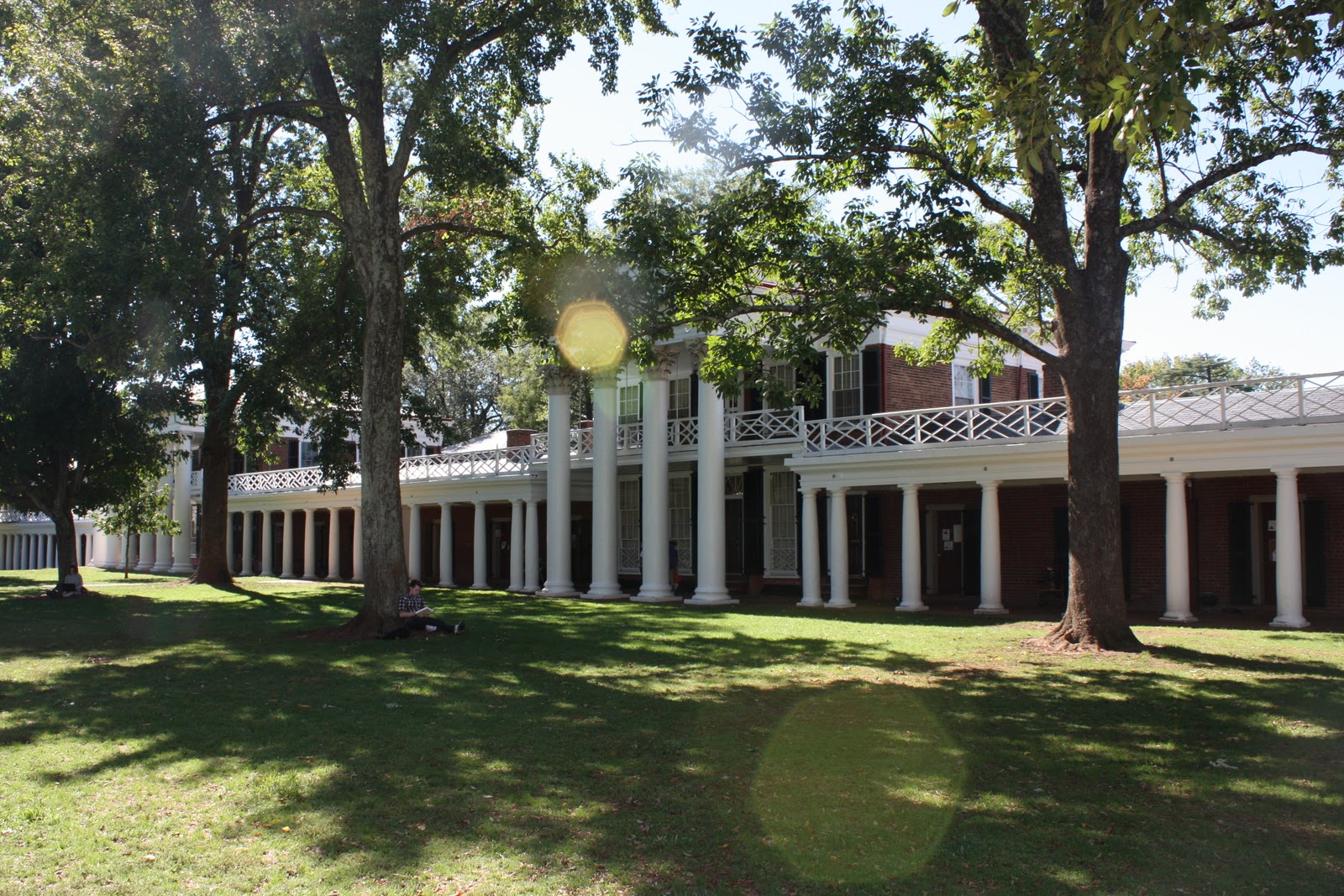
Spent Friday in the bowels of the Alderman library but escaped for a tour. The main building - or rotunda - overlooks a green with academic "villas" down either side. Jefferson fathered the university - if that is the right word - in 1819 and it was up and running by 1825, so he was able to see it. He died on 4 July 1826 - 50 years to the day after the signing of the Declaration of Independence and on the same day as another founding father - John Adams. John Adams's final words - after Jefferson had died - were "Jefferson lives". No twitter.

The university is different from most founded at the time or before as it doesn't have a church or chapel in the main part - education is the most important thing - 1st years face the rotunda when they arrive and for graduation they face away, ready to take their learning to the outside world. See I was paying attention!


Here's one of the academic villas - there are 10 and they are all slightly different - different style columns, different friezes etc. This one has a plaque to commemorate the person who died of a heart attack when that balcony collapsed during graduation a few years ago.


The villas used to have classrooms on the bottom and the teachers upstairs - but now the teachers have the whole building to themselves. I presumed I would be given an honoury one for my time here, but it has not been forthcoming. The little rooms between are for fourth year students who have done something very good and it is a great honour to get them apparently. The teachers, or professors all have a very strict uniform - tweed jackets, bow ties and battered leather briefcases. They all walk around looking like they would rather be any where else than there - but I think it would be a fantastic place to be. Apparently on Halloween there is a huge trick or treat party on the main green and all the children of the town are invited etc.

Learnt that UVA has the second highest number of secret clubs of all universities in the US after Harvard. Not sure how they know that if they are secret. The most secret of the secret societies is the 7 Club - they are top top secret apparently and if you want to get a letter to them, you place it in the hand of the statue of Thomas Jefferson in the rotunda. They give lots of money to charities etc. Also got a lecture on how they don't have freshman, sophomores and seniors at UVA as apparently we are all always learning throughout life - so they just have 1st year, 2nd year etc.


The last picture is taken from the top of the Rotunda. The black covers are to protect the column tops. Apparently on Jefferson's final visit, he went to that window and stood there for so long a student brought him a chair and he sat there for two hours. He never returned!

Friday, 1 October 2010

Jefferson still owes us!

Have spent a morning in the bowels of UVA's library looking through microfilms of Donald papers. 1770s account books I admit are an acquired taste - but vital for the Donalds in America as they showed where our wealth came from - and then unfortunately where it all went to. More shame to come, but I shall ration that.

Once again, lots to go through - but going through the lists of who owes us what. Basically we had our account books for the 1770s, then added on interest to the debts - which is actually higher than the original debt - and then submitted them to the US government at the end of the 18th century to sort out for us.

On James and Robert Donald's book, there is a debt that rather stood out - one Thomas Jefferson from Albermarle. He had then owed us £15.17.10 for 27 years - so the interest came to a very reasonable £21.9.3 on top of that. The notes from 1802 say - Living in Albermarle and our agent on the ground, Pleasant Martin, reports that "Estate Sufficient".

I see no record of him having paid this. What say I take the box of 12 decanters from his study and we shall call it quits? I am no mathematician - but I am sure at the Donald rates of interest, he probably owes us quite a bit by now.

I still find it amazing that over 25 years after an original debt we really though that if we found these people and said - oh, remember before the war you bought a nice clock from Scotland from us - well, we want the money now and over 25 years worth of interest. Did we really expect them to pay? Gilbert Hamilton obviously did, but we shall get to him later.

Also noticed that the Randolphs owe us quite a bit - Miss Jefferson married a Randolph and Alexander was a great friend always writing to Jefferson about dining with them. Also Grant Gilmore claims Randolph heritage - I reckon if he does have Alexander's copy of Voltaire if he chucks that our way, we shall say no more about those debts either.